
For decades, remittances have been one of the most important financial lifelines connecting Southeast Asia(SEA) to the rest of the world.
Millions of workers send money home every month.
Thank you for reading this post, don't forget to subscribe!But what happens after the money arrives?
Too often, the journey ends with consumption, bills and short-term needs.
What if we could build a financial system where a remittance becomes the starting point for savings, investing and long-term wealth creation?
That is the opportunity we see at InveStar.
The next evolution: Remittance → AI → Investment
The first generation of fintech made it easier to move money.
The next generation should make it easier to understand and grow money.
We believe the combination of agentic AI + regulated digital-dollar infrastructure + wealth-tech can create something fundamentally different.
Imagine a migrant worker in New York, Dubai or Singapore sending $500 home.
Today, that transaction may involve multiple intermediaries, FX conversions, settlement layers and fees.
In the future, regulated digital-dollar infrastructure could make the movement of value significantly faster and more efficient.
But the real opportunity starts after the money arrives.
An AI financial agent could help the recipient:
- Understand how much they can safely spend
- Build an emergency fund
- Set savings goals
- Learn about financial products in Bangla or their local language
- Identify suitable investment opportunities
- Understand risk before investing
- Avoid financial scams and fraud
- Track their growing net worth
The transaction becomes more than a transaction.
It becomes a financial journey.
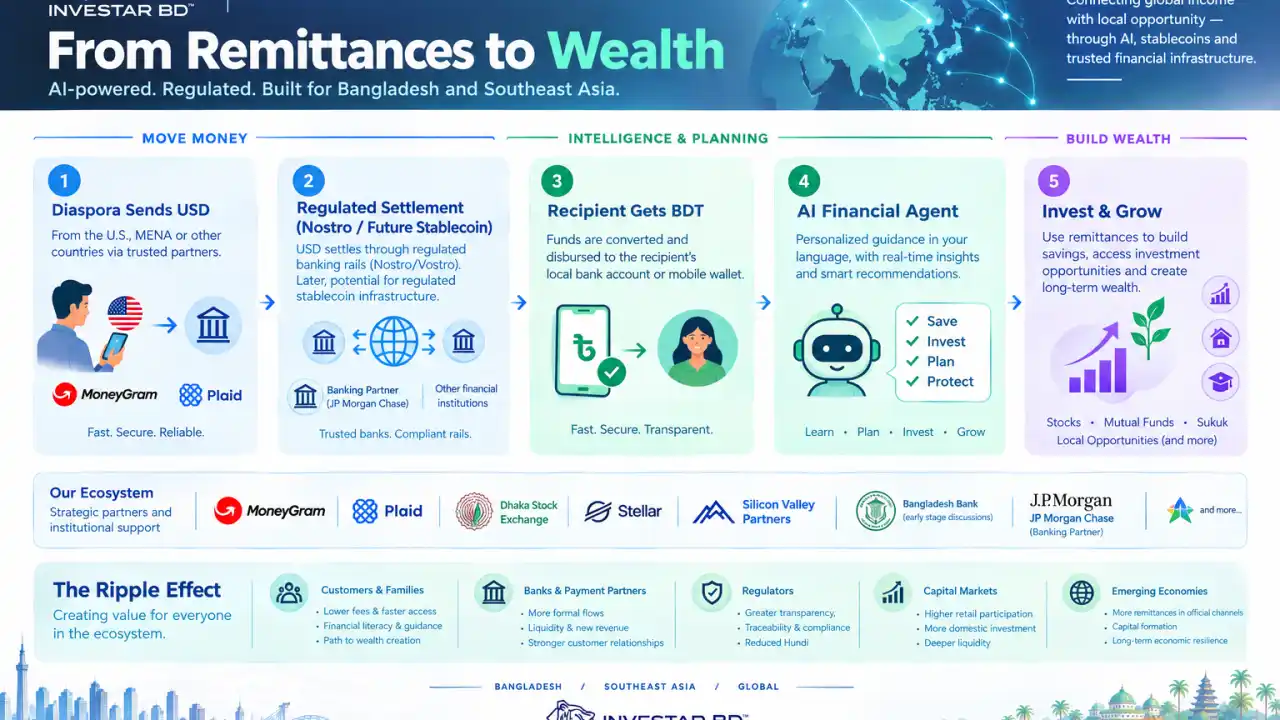
Remittance → Financial Literacy → Saving → Investing → Wealth Creation
That is the model we are building toward at InveStar.
Why stablecoins matter—but not in the way people think
The conversation around stablecoins is often dominated by technology.
We think the more important question is:
What economic problem can the infrastructure solve?
A regulated stablecoin is essentially a digital representation of value designed to maintain a stable price, typically backed by high-quality liquid assets such as U.S. dollars or short-term government securities.
The significance is not that money becomes “digital.”
Money is already digital.
The opportunity is to create always-on, programmable and potentially more efficient settlement infrastructure for global money movement.
Major financial institutions are increasingly exploring this direction.
Standard Chartered, for example, has been developing capabilities around stablecoins, tokenised deposits, digital assets and cross-border settlement.
The U.S. has also established a federal framework for payment stablecoins through the GENIUS Act.
The direction is becoming clearer:
Digital-dollar infrastructure is moving from an experimental technology conversation toward a financial-infrastructure conversation.
But regulation comes first
We don’t believe Southeast Asia should simply copy whatever happens elsewhere.
Every market has its own regulatory framework, banking infrastructure and consumer-protection requirements.
For Bangladesh, for example, USDC-based settlement is not currently permitted.
So our approach is phased and regulation-first.
The near-term opportunity is to work with regulated financial institutions using existing Nostro/Vostro banking infrastructure.
A simplified model could look like:
Diaspora USD → Regulated Banking Rail → Nostro/Vostro Settlement → BDT Payout
Then, as regulation evolves:
Diaspora USD → Regulated Digital-Dollar Infrastructure → Licensed Financial Institution → BDT
The technology should sit behind the regulated financial system—not attempt to bypass it.
That distinction matters.
Bangladesh is where we are starting
Bangladesh receives tens of billions of dollars in remittances every year.
Yet a significant opportunity remains to make those flows:
Faster. Cheaper. More transparent. More productive.
One major challenge is Hundi—the informal movement of money outside official channels.
If formal channels become substantially more convenient and competitive, more diaspora money can potentially move through regulated institutions.
That creates benefits beyond the individual transaction:
More formal remittance flows → stronger financial visibility → greater liquidity → more savings → deeper capital markets → more investment.
And this is where our vision at InveStar becomes particularly interesting.
From sending money home to investing back home
We want to help transform the relationship between the diaspora and emerging markets.
A Bangladeshi living in New York should not only be able to send money to their family.
They should eventually be able to say:
“I want part of this month’s remittance to support my family’s needs, part to build savings, and part to invest for the future.”
The same principle can eventually apply across Southeast Asia.
From Bangladesh to the Philippines.
From Indonesia to Vietnam.
From India to other emerging markets.
The corridors will differ.
The underlying opportunity is similar.
Connect global income with local financial opportunity.
The agentic AI opportunity
Generative AI can explain financial concepts.
Agentic AI has the potential to go further.
With appropriate permissions, controls and human oversight, financial agents could help users execute parts of their financial journey:
Understand → Plan → Save → Invest → Monitor → Learn
But we should be careful.
The same AI that can democratize financial knowledge can democratize financial fraud.
AI can generate convincing scams, impersonate voices, manipulate users and produce unsuitable financial recommendations.
So financial AI must be built differently.
We believe:
AI should explain before it acts.
And when the stakes are high, a human should remain in the loop.
Privacy, suitability checks, fraud monitoring, transaction limits, audit trails and clear AI disclosure should be designed into the system from day one.
The bigger opportunity: Southeast Asia
The opportunity is much larger than Bangladesh.
Southeast Asia has:
- Hundreds of millions of consumers
- Large migrant populations
- Significant cross-border remittance flows
- Rapid smartphone adoption
- Growing digital financial services
- Expanding investment participation
- Increasing interest in AI
- Developing digital-asset and stablecoin infrastructure
The question is not whether every country will adopt exactly the same technology.
The question is:
Can we build financial infrastructure that connects people, money and opportunity across borders more efficiently?
We believe the answer is yes.
Our ecosystem
InveStar is building this vision at the intersection of AI, remittances and wealth-tech.
We are building across an ecosystem that includes Nasdaq Center, MoneyGram, Plaid, Dhaka Stock Exchange, Stellar and Silicon Valley partners. MoneyGram’s on/off-ramp infrastructure is particularly interesting for the next phase of our vision, because it can connect digital-dollar settlement with physical cash access in markets where banking penetration remains uneven.
We are also in early-stage discussions with relevant financial authorities around the broader future of regulated digital-dollar settlement.
At the banking infrastructure level, we are exploring a phased approach with institutions including top local banks—starting with traditional USD/Nostro settlement and, as regulation permits, potentially moving toward regulated stablecoin infrastructure.
This is not about replacing banks.
It is about giving banks, regulators, payment companies and technology platforms better infrastructure to serve customers.
What success could look like
Imagine a future where a migrant worker sends money home and, within the same financial ecosystem, their family receives not just money—but financial intelligence.
The AI explains where the money went.
It helps build a savings plan.
It identifies appropriate investment options.
It helps the family understand risk.
It tracks progress toward financial goals.
And the diaspora member can see the wealth they are helping create back home.
The outcome is powerful:
For customers: lower friction, better financial knowledge and a path from income to wealth.
For banks: more formal flows, stronger customer relationships, liquidity and new financial-services opportunities.
For regulators: greater transparency, traceability and potentially stronger formal-channel adoption.
For capital markets: more retail participation and productive domestic investment.
For emerging economies: remittances that contribute not only to consumption, but to long-term capital formation.
For InveStar: the opportunity to become a financial operating layer connecting diaspora income with emerging-market wealth creation.
The bigger idea
We don’t believe the future of fintech is simply:
“How do we move $1 faster?”
It is:
“How do we make that $1 create more economic value?”
That means moving from:
Remittance → Transaction
to:
Remittance → Financial Intelligence → Saving → Investment → Wealth
And eventually:
Global Income → Local Capital → Long-Term Wealth Creation
That is the future we are building toward at InveStar.
We are starting with Bangladesh.
We believe the opportunity extends across Southeast Asia—and eventually other emerging markets around the world.
Because the ultimate goal isn’t simply to move money.
It is to turn the movement of money into the movement of opportunity.
For Bangladesh, we believe USDC-based settlement should only be pursued once an appropriate regulatory framework and approval are in place.
#Fintech #AI #AgenticAI #Stablecoins #Remittances #SoutheastAsia #Bangladesh #WealthTech #FinancialInclusion #DigitalFinance #InveStar